
Food Metagenomic Data: Updated database with >3,4k samples
News from University of Trento
A new version of the curatedFoodMetagenomicData (cFMD) resource, developed within the DOMINO project by the University of Trento, has been released. The latest versions—cFMD v1.3.0 (November 2025) and cFMD v1.3.1 (February 2026)— enhance the quality, completeness, and scientific value of this unique food microbiome resource.
With these releases, the cFMD now contains 3,444 food metagenomes, representing over 85 food metagenomic datasets from a wide variety of food products and global locations.
What is the cFMD?
The cFMD is a curated, open resource that compiles:
- High quality curated metadata on food samples
- Taxonomic profiles, showing which microbes are present
- Functional profiles, showing what microbes are capable to do
- Reconstructed microbial genomes
This allows researchers to explore the microbial diversity present in foods and study how these microbes may affect food quality, safety, fermentation, and even potential links with the human microbiome.
Key Updates Introduced in Previous Release (v1.2.1)
The earlier v1.2.1 release had already brought major growth to the database, which originally began with the 2,533 publicly available food metagenomes (including from the EU-funded MASTER project).
This previous release included:
- 835 new food metagenomes from 26 studies
- Over 3,400 newly identified microbial genomes
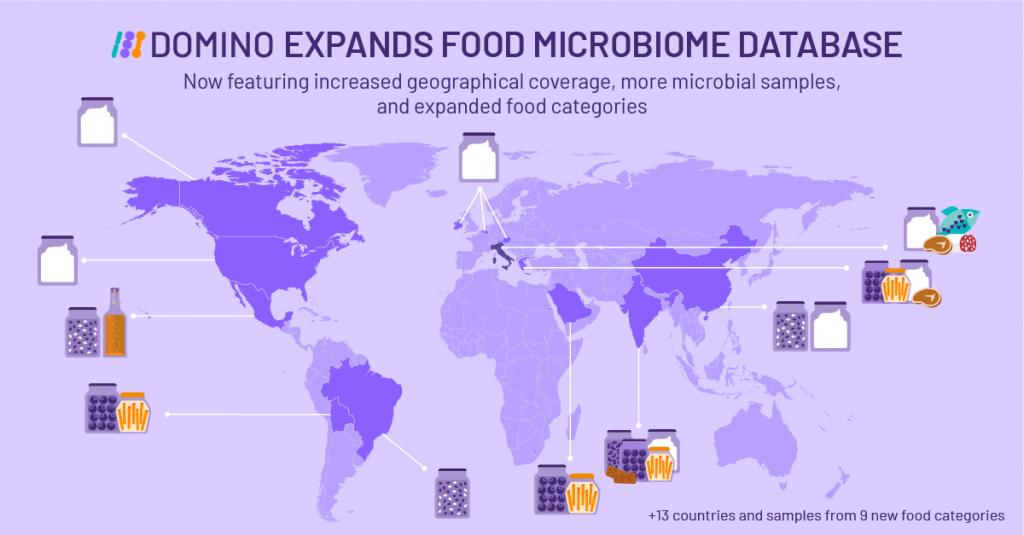
- Coverage expanded to 13 countries, including the addition of Brazil
- Inclusion of new food types such as fermented cocoa beans and green papaya pickle
The broader dataset strengthened the cFMD’s value for researchers and industry stakeholders focused on food safety, quality, and nutrition. This expansion helped researchers explore over 1,000 microbial species shared between human and food microbiomes, strengthening the importance of studying the food–human microbiome axis.
NEW UPDATES
The most recent updates—cFMD v1.3.0 and cFMD v1.3.1—focus on improving taxonomic accuracy, updating microbial genome classification, and enriching the cheese specific portion of the database.
cFMD v1.3.0 (Released November 2025)
This release focused on re‑analysing older samples using updated databases and methods, ensuring the entire collection is consistent and up to date. Here’s a summary of the 3 key updates:
- Updated microbial genome classification using the new MetaRefSGB database
Older metagenomes from earlier cFMD releases (3,310 samples) were re‑processed using the newest genome reference database. This allowed researchers to detect more microbial species and strains accurately.
Key outcomes included the classification between prokaryotic and eukaryotic SGBs (species level genome bins):
- 1,153 prokaryotic SGBs (+117 new)
- 110 eukaryotic SGBs (+2 new)
Among the prokaryotic SGBs, 693 are known species (those with isolated genomes). 460 are yet-to-be characterized species, detectable only through metagenomic data.
- Discovery of 61 new food specific microbial species (ufSGBs)
These are microbial species found only in food and not in humans, soil, animals, or food processing environments.About half could be classified up to the genus level, with common genera including: ‑processing environments.
- Acetobacter
- Pseudomonas
- Brevibacterium
These discoveries highlight how much unique, unexplored microbial diversity exists in food.
- Improved taxonomic profiling using MetaPhlAn 4
All metagenomes were re‑profiled with the latest MetaPhlAn 4 marker gene database, ensuring the most accurate and consistent taxonomic assignments to date.
cFMD v1.3.1 (Released February 2026)
This release focuses especially on cheese microbiomes, aligning them with the MetaCheeseDB reference. This helps improve the reliability of studies on fermented dairy products. The key updates include:
- Addition of two new cheese metagenomic datasets
- 134 new cheese samples added, increasing cFMD sample count to 3,444
- Extended metadata for all cheese samples in cFMD
These new samples were profiled using the same methods introduced in v1.3.0, ensuring direct comparability across the entire resource.
Why do these updates matter?
Together, these updates:
- Increase the accuracy of microbial identification
- Reveal new, previously unknown food-specific microbes‑specific microbes
- Expand the coverage of important foods like cheese
- Strengthen the connection between cFMD and specialised databases like MetaCheeseDB
- Support research in food safety, nutrition, fermentation, and microbiome science
The cFMD continues to be a cornerstone resource for anyone studying the microbial landscape of the foods we eat.
Definitions:
1Metagenome refers to the genetic content of any group of microorganisms.
2Eukaryotic genomes refer to the complete set of genes or genetic material present a eukaryotic cell (in this context present in food).
3 Prokaryotic genomes refer to the complete set of genes and genetic material present in a prokaryotic cell.
4 SGB (species level genome bins) refer to a genome-based definition of a microbial species.
Access and further reading
🔗 Explore the FMD database: Food Metagenomic Data (FMD)
🔗 Scientific publication: Unexplored microbial diversity from 2,500 food metagenomes and links with the human microbiome
🔗 Check out the cFMD workshop held for DOMINO partners: Workshops – DOMINO
🔗 Read more about University of Trento and his involvement in DOMINO: UNITN – DOMINO.