
Living labs
The DOMINO project involves six different living labs across various countries, all contributing to the overarching goal of developing new functional foods that promote healthy and sustainable food systems. Each living lab organises sessions with diverse stakeholders to gather insights, foster collaboration, and refine their approaches.
Living labs in DOMINO
Domino living labs have 4 main goals: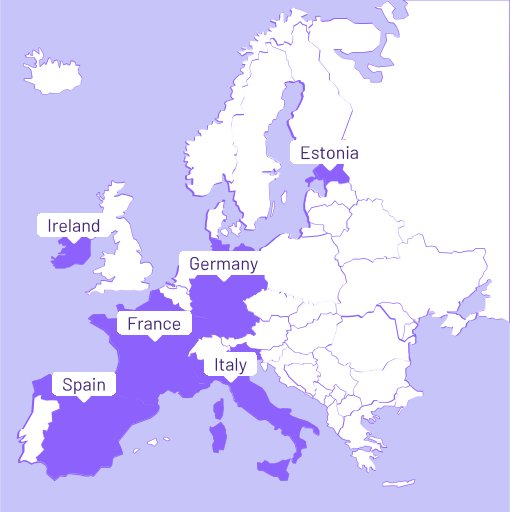
- To set living labs activities for a multi-actor co-creation around the plant-based Fermented Food prototypes.
- To assess consumers’, citizens’, and producers’ perception and acceptance of Fermented Foods and awareness regarding health and sustainability aspects.
- To describe the market and innovation potential for Fermented Foods.
- To test the project’s Fermented Food prototypes within the dynamic, interactive living labs.
Domino’s living lab activity is divided in three phases, from March 2023 to February 2028.
During phase I, barriers to the consumption of fermented food were identified by participants. In the document “Report on outcomes Living Lab sessions up till end of phase 1” you can find an overview of the key barriers to transforming current food systems, addressing both broader systemic challenges and specific obstacles to adopting fermented foods. Below a summary of the findings.
Barriers and obstacles for transformation food system
The transformation of our food system faces significant challenges, which can be grouped into three main themes:
- Convenience and lack of time highlights how busy lifestyles drive demand for quick, easily accessible food options, often at the expense of quality.
- Distrust and ambiguity capture consumer concerns about misleading advertising, information gaps, and power imbalances in food production.
- Grand challenges encompass systemic issues like overconsumption, overproduction, and resource strain due to population growth, all of which threaten long-term sustainability.
Barriers and obstacles for adoption of fermented foods
The adoption of fermented foods faces a range of barriers, categorized into themes: health, planet, social, knowledge and cultural factors. Health concerns highlight perceptions of FFs as processed and potentially unsafe, while planetary issues address environmental risks related to global trade, waste, and overproduction. Social factors emphasize communal enjoyment of food, though media and peer pressure often lead to conformity over personal preferences. Additionally, significant knowledge gaps hinder understanding of fermented foods, including their processes, health impacts, and benefits. Lastly, cultural embeddedness illustrates how fermented foods strengthen community ties, preserve traditions, and evoke nostalgia.
What are living labs?
Over the past decade, living labs have emerged as platforms for multi-stakeholder collaboration in the context of transitions towards sustainable systems. Especially in cases that require the collaborative development of co-benefits in the context of conflicting interests, living labs have the ability to foster mutual understanding and catalyse socio-technological innovation that accommodate co-benefits.
Living labs are defined as “settings for experimentation and testing of ‘solutions’ to sustainability challenges in collaboration with various actors”. According to this, living labs are user-centred environments where stakeholders from various sectors – such as academia, industry, government, and civil society – converge to share knowledge, co-create solutions, and explore innovative alternatives. The multitude of perspectives, expertise, and resources brought together by participants are fundamental to fostering innovation and scale up innovation and businesses.
Click here to know more about the timeline of Domino’s Living Lab activities.
Learn more about the Domino Living Lab in this news post, summarising the publication, “DOMINO: Co‑creating Fermented Food Products Through Living Labs”.
Read also “More than a gut feeling“, an insights on French and Irish Living Labs results published by Teagasc.